I’ve been a lifelong fan of ET stories. Not in the tinfoil-hat sense—but in the meditation sense. The symbolic sense. The consciousness sense. I’ve always felt that looking to the stars helps us look inward. So this realization caught me off guard.
Watching Ancient Aliens last night, something finally landed that I’d heard murmured for years but never fully felt: there’s a quiet assumption at the heart of the premise that deserves scrutiny.
That ancient, largely non-white civilizations must have had outside help to build their cities, temples, and architecture.
It’s rarely stated outright.
It’s implied—again and again.
When whites build cathedrals, it’s called genius.
When Indigenous people of color build monuments that defy modern expectations, it becomes mystery.
And mystery, when handled carelessly, turns into erasure.
High-quality reads if you want receipts:
SAPIENS on pseudoarchaeology’s racist roots,
Smithsonian’s critique of “Ancient Aliens” claims,
and a Science magazine report on why myths like Atlantis/ancient aliens spread—and why scholars push back.
The Prime Directive as moral compass
This is where my mind jumped immediately to the genius of Gene Roddenberry and his creation of the Prime Directive. Not as sci-fi lore, but as philosophy.
The Prime Directive says:
You don’t interfere just because you think you’re more advanced.
No saviors.
No cosmic missionaries.
No outsiders stealing credit for someone else’s evolution.
That single idea quietly dismantles colonial thinking—on Earth or in space. And it exposes where Ancient Aliens often slips: by outsourcing human brilliance instead of trusting it.
Reclaiming Puma Punku—without killing the wonder
Consider Puma Punku within the UNESCO-listed Tiwanaku complex.
The stonework is staggering. Precision cuts. Interlocking geometry. Engineering that still humbles us. The reflexive question becomes: How could they have done this?
The lazy answer is aliens.
The better answer is harder—and more humbling:
humans were capable of far more than we remember.
Here’s where I offer a fictional reframe—not as replacement history, but as myth in the old sense: a lens that preserves wonder without stripping agency.
Imagine a brief peak in human evolution—not a permanent state, but a moment—when consciousness itself was more coherent.
Not psychic in a comic-book way.
Psychic as in resonant.
A culture that understood stone not as dead matter, but as vibration. A people who worked in synchronized states of breath, rhythm, and intention—aligning mind, body, and environment.
In that state, stone didn’t need to be “lifted” the way we lift things now.
It needed to be persuaded.
Sound.
Rhythm.
Focused attention.
Levitation not as spectacle, but as side effect.
Puma Punku wasn’t built by visitors from the sky.
It was built by humans briefly remembering how deeply they belonged to the Earth.
Want a grounded “how did they move/fit stones?” counterweight alongside the wonder?
Live Science overview of Tiwanaku & Pumapunku
and National Geographic on Tiwanaku’s ritual world
give readers solid context without deflating the awe.
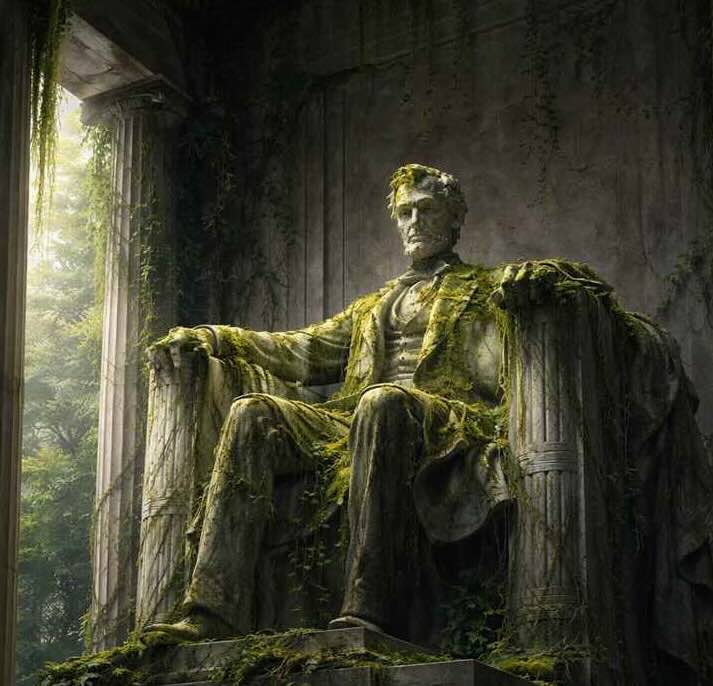
And our “modern” civilization, the largest so far of our species is not immune to falling on its own hubris. Falling out of love with itself. Imagine archeologists of the future saying we whites of this era were given our tech, our medical advancement by aliens. Doesn’t feel so hot does it?
The longer, harder truth
Zoom out far enough and a pattern emerges:
We rise.
We build.
We master something profound.
We weaponize it, mythologize it, or hoard it.
We collapse.
We forget.
Then survivors start again—staring at ruins, underestimating their ancestors, inventing stories to explain away what feels impossible.
Aliens become an easy answer when humility is harder.
But here’s where I land now—and this is the part that finally reconciles my love of cosmic mystery with responsibility.
Where inspiration really comes from
I still believe in divine inspiration.
I still believe the universe whispers.
Just not as construction crews landing to do our work for us.
Thought itself is energy. And energy doesn’t respect borders, planets, or time. It ripples—forever. The good and the bad alike. Across civilizations. Across star systems. Across eras.
Every so often, those ripples intersect.
And BAM—an idea lands.
A leap in technology.
A breakthrough in medicine.
A melody that feels like it always existed.
A film that arrives whole.
An architectural insight that skips centuries of trial and error.
If you’re curious how I think about “downloads” in the creative process (especially film), that thread runs through our work at
Overactive Imagination Pictures.
Not everyone receives those downloads.
Only the most tuned-in do.
Only the most coherent.
Only those whose ego is quiet enough to let something larger move through them.
That’s not racism.
That’s not hierarchy of race or culture.
That’s evolution of consciousness.
Different civilizations across the earth reached that coherence at different moments—long enough to build something astonishing. Long enough to leave behind evidence that later humans, more fragmented and less attuned, struggle to explain.
So we reach for aliens and call them Gods, even robbing the indigenous of divine wisdom.
But maybe the universe is doing something simpler—and more elegant.
Maybe it seeds ideas where from other worlds psychically they’re needed, when they’re needed.
Self-preserving.
Self-correcting.
Self-expressing.
And humanity? We’re not spectators.
We’re receivers.
Sometimes we listen.
Sometimes we forget.
Sometimes we destroy what we once understood.
And then—because thought travels forever—we remember again.
That’s the story I’m choosing now.
Not Ancient Aliens.
Ancient humans. Ancient builders.
Cosmic ideas.
And a universe that keeps trying to wake us up.
“There is nothing more dangerous than sincere ignorance and conscientious stupidity.”
— Martin Luther King Jr.
This reflection is dedicated to Martin Luther King Jr. on Martin Luther King Jr. Day—whose insistence on truth, dignity, and intellectual honesty continues to challenge how we tell history, whom we credit, and whose genius we allow ourselves to see.
If you’re drawn to the “consciousness sense” of ET symbolism (without the colonial baggage), you might like exploring more reflections and guided, nervous-system-friendly meditations to cool you down at Coolest Meditation Ever.
Many people also explore ways to stay energetically coherent in an increasingly noisy technological world—whether through meditation practices or tools designed to support subtle energy balance.
One option some readers ask about is the BlueShield EMF Protection Evo Pyramid.
For cool tech to uplevel your health, visit our Self Care Is Self Love Store at CoolestTechEver.com.
 Media, Meditations & Musings